Who are they? What do they do?
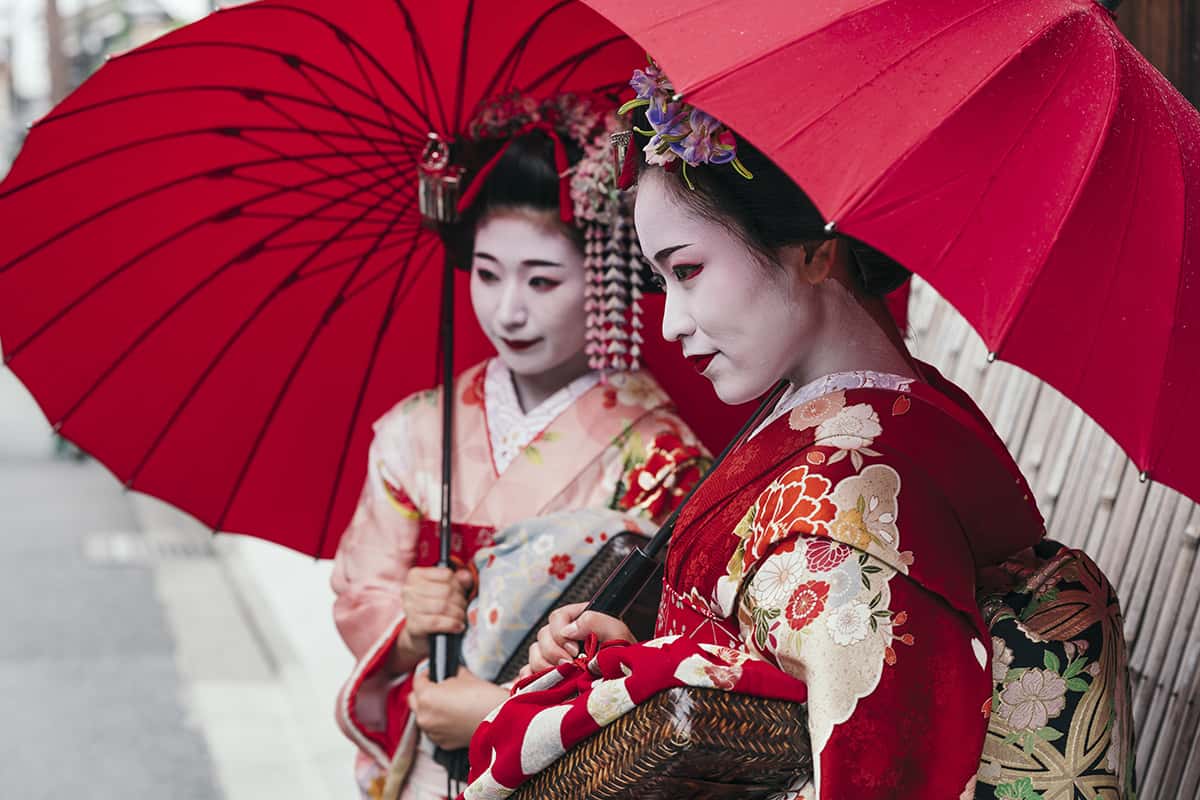
Masko Tanaka born in 1949 was raised on the grounds of potential. At just five years old, she was sent away to study Japanese dance performances at the most elite hanamachi (house Geisha women), Gion District of Kyoto. Being left in charge to be the heir of the house, and taking the surname of Iwasaki, she began maiko or geisha apprentice at fifteen years old. This was a huge step for Iwasaki because of the grounds in which Geisha woman are discovered, trained, and established. Dressed in an elaborate kimono and hair in nihongami style, by the age of sixteen Iwasaki learned how to pour tea, dance, and make flirtatious conversation (Tran, 2019). At just twenty one Iwasaki was made the most popular Geisha in Japan. Despite Iwasaki’s reputation of being an escort, she specifically specializing in entertainment. After, many years of the same tiring work Iwasaki retired from her Geisha duties. Although, Geisha are raised on the basis of entertainment, their lack of knowledge and education causes difficulties in entering into a new career. As one of the main rules of the Geisha occupation is to keep content and duties a secret. Could it be that the strange rules regarding the Geisha is what gives the Geisha women their reputation? Without Iwasaki going against the rules of committing to a lifetime of silence regarding Geisha, the world may have never known the truth of the Geisha women.
My topic
I will be examining the topic of Geisha Women within the Japanese society. My argument is that the Geisha carer is not a deviant carer rather a perceived deviant occupation, Geisha women are not escorts, and Geisha women are strictly entertainers. I will argue against the deviance of this subculture within society.
Beginning History of Geisha

The Geisha subculture is over four hundred years old and is well known in different areas of Japan. The Geisha subculture began with only men in the industry known as comedians and throughout time, the Geisha subculture switched to strictly female members. Females continued the entertainment in performing arts within society. Although, the group continued on similar more feminine entertainment, the group quickly developed the negative connotation of being prostitutes and escorts amongst society. Becoming a Geisha woman is a strict and requires distinct guidelines.
The Geisha Female
- The Geisha subculture has only female members
- The Geisha group is an entertainment source of Ancient Traditions of Art, Dancing, and Singing in Japan.
- The Geisha typical look consists of appearal in the kimono and oshiroi makeup
Training
While training and gaining the term of Geisha, emerging entertainers are called “maiko.” Training for the subculture takes about five years, but again one cannot decide to be in the Geisha subculture group, they must be born or adopted into the family of the performer. The cost is about $500,000 to train continuing throughout life and not stoping education of the entertainment industry (Tameyn, 2019). During training it is common for the maiko to be a maid or service of help to the Geisha higher up which goes against the mainstream culture of no families having maids in Japan. Geisha entertainers perform at high end dinners, parties, and private events. There is a strong negative thought of Geisha performers as strippers or prostitutes making them fall into a subculture role.
Life of a Geisha Performer
While training Makio students live in the Okiya or the Geisha house under the guidance of the Kami-San which is considered the mother of the house. During the give year training process makio are not supposed to be in a romantic relationship or get married. Their dedication is focused towards training. After training, the Geisha women are free to live where they want, or start a family. Some even open their own entertainment businesses or their own Okiya. Performances of a Geisha costs around $900 USD upwards (Taemyn, 2019). Even if one is able to afford the cost of a Geisha performer at a private event or at a Geisha performance place they may not be able to receive the entertainment. It is a secretive subculture that means you must have introduction from previous Geisha customers or an invitation to be apart of understanding and enjoying the subculture.
Institutions, Demographics, and Power
Power– The subculture is maintained because you can only be born into or adopted into a family of Geisha females that carry and withhold the tradition, one may not choose to be apart of the subculture. Society has the power to shape these groups because when it was all male members, they were considered comedians but when the group changed to females the group was then perceived negatively and as prostitutes. Males had the power to distinguish themselves as comedians, but females didn’t have the power to define themselves as entertainers and not prostitutes or escorts. The origination of the Geisha rules and regulations could distinguish the power of who determines the connotation for the Geisha group. Considering the Geisha woman are held to high expectations of rule following of not displaying information of the subculture, it disregards the members of the groups chance to develop an accurate representation. Customers of the Geisha performances also hold the power. Considering that the customers are seeing first hand that the Geisha woman were strictly only performing and not escorting, but not changing the thought of Geisha woman holds them with the power of distinguishing their connotation further.
Institutions– After World War Two, Geisha women were mistaken for prostitutes by the USA Army. Laws were enforced to prevent Geisha women from stealing prostitutes clients, in a way the Japanese government declared this negative connotation of Geisha women being prostitutes by passing this law. Financial institutions can make it difficult for those who are born into the families to continue on their Geisha education because of the high cost. from $500,000 and then $50,00 kimonos, it can be difficult to cover the costs. Often times, Japanese males pay for the education and fashion attributes of the Geisha women to alleviate the price and produce more Geisha women. This is done because the males consider the entertainment worth it. Geisha career would be considered a deviant career defined by Becker, because of the deviance idealizations it holds within society. Since education is highly valuable within the Japanese culture, the lack of education that Geisha woman have within society can present them as the deviant subculture further.
Demographics–
- Difficult to attract younger generation because of the failure to move outside their group to attain new members. Struggle to keep the traditions of the traditional Geisha culture but the Geisha people see the need to develop a new plan to receive new members.
- There previously was around 80,000 people in the Geisha group in present day, there is roughly between 1,000 and 2,000 members- desperately seeing the need for a recruiting change (Ito).
- Females account for 68.2% of the working force in Japan (Statistics Bureau).
- Group entails only females
Mainstream Japanese Culture
- Education (elementary, high school, and higher education is highly valued)
- 40% of students attend a higher education program than high school (Statistics Bureau)
- Very low crime rate- 19.8% crime rate (Statistics Bureau)
- Rare for a Japanese family to have a maid
- Very Conservative
- Wears kimonos, but only to special occasions
- Rarely wears the common makeup of the Geisha subculture
Do Geisha Woman go against mainstream Japanese Culture?
The Geisha woman have many characteristics that could entail them to be apart of the mainstream Japanese culture, but also Geisha woman characteristics can go against the mainstream Japanese culture in many ways. The Geisha woman are well known in society but they are known for the wrong reasons. The Geisha woman can align with the mainstream Japanese culture when they are known for their actual occupation. because they are providing entertainment to the elite class in Japan. On the other hand, Geisha woman are perceived as deviant because of their reputation of being escorts. Their reputation can go against mainstream Japanese culture because being an escort is illegal in Japan and the crime rate in Japan is extremely low. Additionally, when one is born into a Geisha oriented family they are raised as such. From a young age training takes over individuals life and there is little no room for education or higher education. Considering that education is highly valued within the Japanese culture and Geisha woman are low in education this also goes against mainstream Japanese culture. Although, Geisha woman don’t entail the socially desired education, their training and learning is so extensive and should be appreciated for its actuality. Goffman describes a stigma as different and less desirable attributes that go against the societal norms of behaviors in that area (p.3). Goffman suggests that these differences rarely produce dangerous, bad, or weak (p.3). Geisha woman have less desirable attributes that go against societies values within an individual therefore, it creates a further stigmatization of deviance among these woman when the deviance is false.
Goffman’s View on stigma of a deviant group
Goffmans three types of stigma include…….
- Abnormalities of the body (Ex- piercings)
- Blemishes in someone’s individual character (Ex- mental disorder)
- Race, Nationality, Religon (Ex- passed down from family members)
Stigma is placed into the Geisha woman based on features and roles that are passed down from family members. Although, being a Geisha woman isn’t a race, nationality, or a religion it is a way of life for many people and many families that is passed down and has stigma placed around generations to generations. Although, the Geisha group maintains distinct clothing and makeup, it is hard for a Geisha woman to engage in passing to the stigmatization but Geisha family members can do what Goffman suggests is “adapting to normal behavior” and enter into a different type of occupation. Although, this might be difficult because training for a Geisha performer must start at a very young age in which parents and families have heavy influences over their children’s decision.
Labeling Theory
Much of Japanese society and societies around the world perceive Geisha woman as deviant and escorts. The surrounding society labels Geisha woman as deviant because their reputation of being escorts. When in fact, the reputation they carry is false, and they are strictly entertainers for upper class Japanese men and woman. Therefore, the group is labeled wrong within society especially being labeled as deviant.
Geisha woman being perceived wrong causes a MORAL PANIC
Stanley Cohen would consider the Geisha group a moral panic because of the connotation that society and the media places on the culture of being females prostitutes. Becker would argue that the audience determines the thought of the social schema because of their influence of opinions on the subculture. Becker would consider this group labeled the deviant subgroup not necessarily because they are deviant, as the Geisha being prostitutes being a false statement, but because they are labeled as “different” than the mainstream culture. With 86.6% of Japanese females participating in hobbies that they enjoy, it is common for the females to enter into the careered hobby that they enjoy.
Who are the outsiders?

As discussed previously, the Geisha woman have strict guidelines as to who can be apart of the Geisha occupation. A Geisha female must be born into the family of Geisha performers. This could leave people who are not apart of the Geisha performer families to be the outsiders. It is only in rare occurrence that people enter the Geisha occupation without family inheritance of the accepted group. Becker suggests that certain groups can create deviance about another social group. Due to the extreme privacy and secrecy of the Geisha group, outsiders away from that specific group could consider the Geisha woman deviant because of the social norm reputation that the group has surrounding them even if it is not true. Another way to look at the Geisha group in terms of outsiders, is to look at the Geisha woman as creating the social norms that inflict outsider status. Considering that the Geisha group of woman have strict rules as to who can know about their group and the ins and outs, could the Geisha woman be inflicting outsider status on themselves?
Thorton’s Subculture Capital
Thorton explains subculture capital as “It confers status on its owner in the eyes of the relevant beholder… It can be objectified or embodied” (11).” the capital that comes from being apart of the subculture can bring wealth and authority to the subculture from resources received from being apart of the subculture. For instance, since the training and apparel is extremely expensive, the resources others have to place Geisha woman through training can be considered capital received from being apart of the subculture. Also the resources such as food and shelter provided to Geisha groups could also be seen as subculture capital for the group.
Entertainers in other countries- General
Although, Geisha woman are originated in Japan in Japanese culture, their reputation remains constant across the world. It is interesting to look at the specific reputations that can be carried across the world of the subgroup. Additionally, it is interesting to look at the different entertainers across the world such as Indian Bollywood Belly Dancing in which performers constantly provide entertainment to people but don’t carry the negative connotation that the Geisha woman carry with them. Many belly dancers consider them artists in the same way that Geisha woman consider themselves artists. Some people perceive belly dancers as part of the prostitution work force, but once again it is a negative connotation surrounding the group. Is the negative connotation surrounded around the people within the group or the entertainment industry as a whole?
References
- The Outsiders. (1983, March 25). Retrieved from https://www.imdb.com/title/tt0086066/
- Cohen, S. (2015). Folk devils and moral panics: the creation of the Mods and Rockers. London: Routledge, Taylor & Francis Group.
- Becker, H. S. (1997). Outsiders. London: Free Press.
- Donna, & Donna. (2018, August 20). 50 AMAZING FACTS ABOUT GEISHA EVERYBODY OUGHT TO KNOW! Retrieved from https://hauteculturefashion.com/facts-about-geisha/
- Ito, M. (n.d.). Japan’s geisha battle to protect their future. Retrieved from https://www.japantimes.co.jp/culture/2017/11/25/general/japans-geisha-battle-protect-future/#.Xlxq55NKgUs
- Statistics Bureau, & Ministry of Internal Affairs and Communications. (n.d.). Retrieved from https://www.stat.go.jp/english/data/handbook/c0117.html
- Tameyan, L. (2019, September 9). Geisha subculture. Retrieved from https://learnourworld.com/2019/09/06/the-culture-of-geisha-girls/
- (n.d.). Retrieved from https://aspectfoundation.org/host/japan.html?gclid=EAIaIQobChMIv_GasdL65wIVFcpkCh3qAwDAEAAYASAAEgIAMfD_BwE
- Thornton, Sarah. 1996. Club cultures: Music, Media and Subcultural Capital (Links to an external site.)
- Tran, C., Mason, D., Tran, C., Mason, D., Mason, D., & Butler, O. (2019, June 17). The Real Memoirs Of A Geisha: The Life Of Mineko Iwasaki. Retrieved from https://www.factinate.com/editorial/real-memoirs-of-a-geisha-mineko-iwasaki/
- Ikuko: My life as a geisha girl. (2011, October 23). Retrieved from https://www.independent.co.uk/news/people/profiles/ikuko-my-life-as-a-geisha-girl-518085.html
- Indian Bollywood Style Belly Dance. (n.d.). Retrieved from https://www.atlantabellydance.com/Overview/Indian.html
- Hays, J. (n.d.). BELLY DANCING. Retrieved from http://factsanddetails.com/world/cat55/sub395/entry-5951.html
 Rylie's Blog